Production planning is one of the most critical processes for any manufacturing company. It directly affects on-time delivery, machine efficiency, operating costs, and day-to-day work organization.
The context and challenges of production planning
Many manufacturing SMEs struggle to keep their production plans stable due to operational variability, incomplete data, and unexpected events on the shop floor.
According to several McKinsey analyses, the lack of up-to-date and reliable data in production processes has a direct impact on productivity, delivery performance, and operational efficiency.
In this article, we explore the five most common production planning errors, why they happen, and how they generate delays and inefficiencies.
Planning with incomplete or outdated data
One of the main reasons production planning fails is poor data quality. Many companies still plan production based on:
- estimated cycle times instead of actual ones;
- manual reports filled in at the end of the shift;
- theoretical values never compared with real performance;
- Excel spreadsheets updated sporadically.
This lack of reliability leads to plans that are theoretical rather than operational. Many manufacturing companies suffer from data inconsistency: misaligned data, manually entered or not updated frequently enough to reflect reality.
The result is a production plan that constantly diverges from what actually happens on the shop floor, creating a vicious cycle: the less accurate the plan, the more often it needs to be reworked.
It is important to make a fundamental distinction:
- Traditional schedulers organize orders and resources using static rules and historical data.
- APS (Advanced Planning & Scheduling) systems promise advanced optimization, but in practice they almost always rely on theoretical times, not on what really happens in production.
As a result, even advanced tools often generate plans that work only on paper.
Why?
- They do not capture micro-stoppages and slowdowns
- They fail to detect real production variability
- They ignore energy consumption, machine states, and dynamic bottlenecks
- They do not update in real time when reality changes
Failing to identify bottlenecks (or identifying them too late)
A bottleneck is the step that limits the speed of the entire production process. But identifying it is not straightforward: it is not always the slowest or the oldest machine. Bottlenecks may appear only during certain shifts, with specific products, or under particular load conditions.
According to the OECD, poor data quality, fragmented information, and manual data collection are among the main obstacles to effective operational planning in manufacturing companies.
The direct consequence is a production plan that does not reflect the factory’s real capacity. And since bottlenecks often change over time, relying on historical data can be seriously misleading.
Managing production reactively instead of proactively
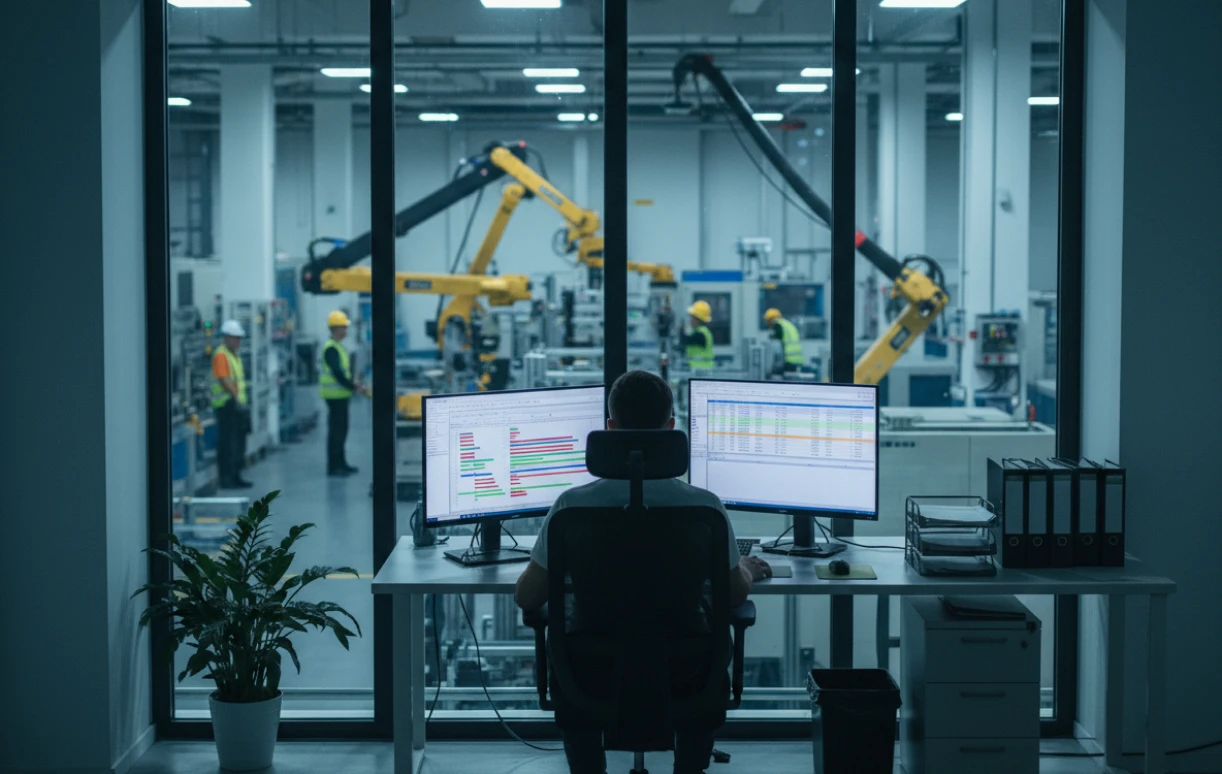
Unexpected events, unreported micro-stoppages, cycle time variations, missing materials, sudden slowdowns: variability is inherent in production. Without up-to-date visibility, however, it becomes unmanageable.
Many SMEs are forced to:
- rework the plan multiple times per day;
- call operators to ask for real-time updates;
- reschedule shifts and setups at the last minute;
- constantly deal with production and delivery delays.
In many manufacturing companies, a significant portion of production managers’ time is consumed by continuous replanning, caused by a lack of real-time visibility into shop floor operations.
The result is a reactive and fragile planning approach that collapses at the first issue. In a complex factory, this model is no longer sustainable.
Using Excel for production planning when it is no longer sufficient
Excel is a flexible and easy-to-use tool, and it is understandable why many companies rely on it for production planning. However, the vast majority of spreadsheets contain errors that can affect decisions and processes. Several studies indicate that around 90% of spreadsheets used in business contexts contain formula or data errors, putting analysis reliability at risk.
The problem is not Excel itself, but the fact that it:
- does not update data automatically;
- cannot manage variability, downtime, energy consumption, and machine states simultaneously;
- does not communicate with machines or ERP systems;
- becomes unmanageable as products, versions, shifts, or constraints increase.
When production planning depends on a file managed by a single person, risks multiply: a single formula error or missing value can disrupt the entire department.
Ignoring real production variability
Variability is the rule, not the exception.
Multiple manufacturing studies show that much of the gap between theoretical and actual cycle times is caused by factors that are difficult to detect with traditional systems, such as micro-stoppages, operational variability, and differences between operators.
If variability is not included in planning, the plan fails.
And when the plan fails, it means:
- delivery delays;
- higher costs;
- inefficient use of resources;
- loss of customer trust;
- constant stress on the shop floor.
Variability cannot be eliminated: it must be measured and managed.
Why does production planning fail? A visibility issue
All the errors described above share a common root cause: the lack of reliable, real-time visibility into production data.
Before talking about advanced schedulers or complex optimization systems, the key question is:
“Do I really know what is happening in my production, minute by minute?”
Robust production planning first requires the ability to:
- know real cycle times, not theoretical ones;
- identify dynamic bottlenecks;
- measure variability day by day;
- visualize downtime and root causes;
- compare performance across lines, shifts, and products.
Without this foundation, even the most sophisticated software solves only part of the problem.
Companies that truly improve their production planning do not start with software—they start with a cultural shift: seeing production as it really is, not as it is expected to be.
When data and processes become transparent, something powerful happens: delays decrease, decisions become faster and more reliable, production capacity is used more effectively, and planning turns into a real operational tool rather than a document to chase.
Overcoming these errors does not mean immediately adopting complex tools. It starts with a simple principle: understanding operational reality as it is, not as it should be. When cycle times, downtime, bottlenecks, and variability become visible, production planning stops being a theoretical exercise and becomes what it should be—a concrete support for daily decisions.
This is the turning point for many companies: moving from reaction to anticipation, from uncertainty to awareness.
And conscious planning is the foundation for everything else: efficiency, delivery reliability, production capacity, and—above all—operational peace of mind.
Share This Story, Choose Your Platform!
About the Author: Alice Benozzi