Under pressure, during an unexpected breakdown, time is not measured in minutes, but in thousands of dollars in lost production.
Having a technical manual is useless if your team spends 20 minutes finding the right page among hundreds of PDFs or dusty binders.
The speed of recovery depends directly on the speed of information access. This is what we call the invisible bottleneck that often holds back production: technical knowledge is fragmented or locked in individuals’ memories.
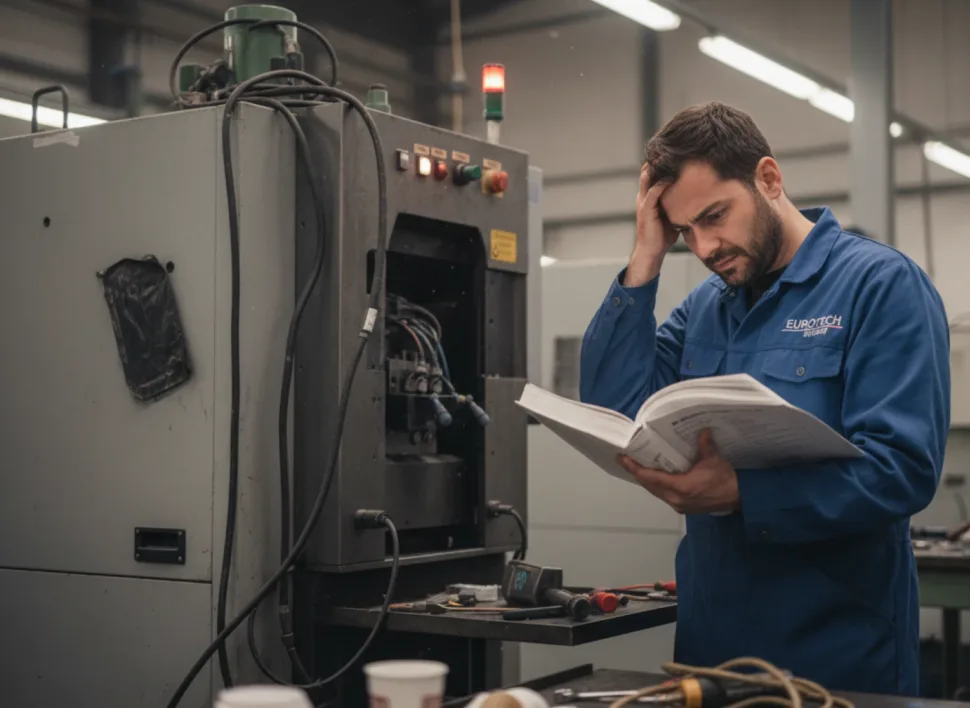
The Hidden Cost of Information Retrieval in Troubleshooting
In a modern production line, machinery complexity has grown exponentially. This means that operation manuals and industrial machinery maintenance have become digital encyclopedias that are nearly impossible to consult quickly.
There is a critical difference between “knowing the solution exists” and “finding the solution now.” Many companies measure maintenance efficiency by tracking only the mechanical intervention time, ignoring the time spent in triage.
Time “on the wrench” is often just a fraction of the total MTTR (Mean Time To Repair). Most of the recovery time is consumed trying to understand the problem and consulting obsolete or incomplete documentation.
Accessibility vs. Documentation: The Secret Weapon for MTTR Reduction
The real enemy of OEE (Overall Equipment Effectiveness) is not the breakdown itself, but uncertainty. When a junior technician faces an anomaly, the inability to instantly access the correct procedure leads to trial and error.
Transforming a passive archive of documents into a proactive assistant system is the first step in unlocking operational scalability and resolving production bottlenecks. Instead of navigating through folders, staff should be able to “query” company knowledge to get precise answers in seconds.
Standardizing interventions through immediate accessibility eliminates guesswork and drastically reduces the risk of human error due to pressure.
A Scalability Side Effect: Shorter Onboarding for New Technicians
Knowledge management isn’t just about repairing breakdowns; it’s about building people. Traditionally, onboarding a technician requires months of passive shadowing of a veteran.
Drastically reducing the weeks needed to make a new hire productive is possible if knowledge is democratized. If a technician can consult validated procedures and technical answers in real-time, the burden on department managers decreases significantly.
This approach de-risks operations: company history is no longer tied only to senior technicians but becomes a digital asset available to everyone, at any time.
Unlocking Your Factory’s Potential
In conclusion, the scalability of modern production isn’t just about faster machines, but about more fluid knowledge. Stop being a victim of documentation and start using it as an active tool—this is the key to lasting operational excellence.
Share This Story, Choose Your Platform!
About the Author: Marco Graziotti