
The efficiency of any manufacturing plant lies in the ability to turn available asset time into actual production.
The gap between a machine being powered on and actually creating value has a direct impact on operating costs and the ability to meet production schedules.
In Zerynth, the Utilization Rate is a metric that maps asset activity through physical signals, eliminating the errors and delays common in manual reporting. Here is a breakdown of how it’s calculated and why shift analysis is the true key to uncovering hidden inefficiencies.
Technical Determination of Machine States
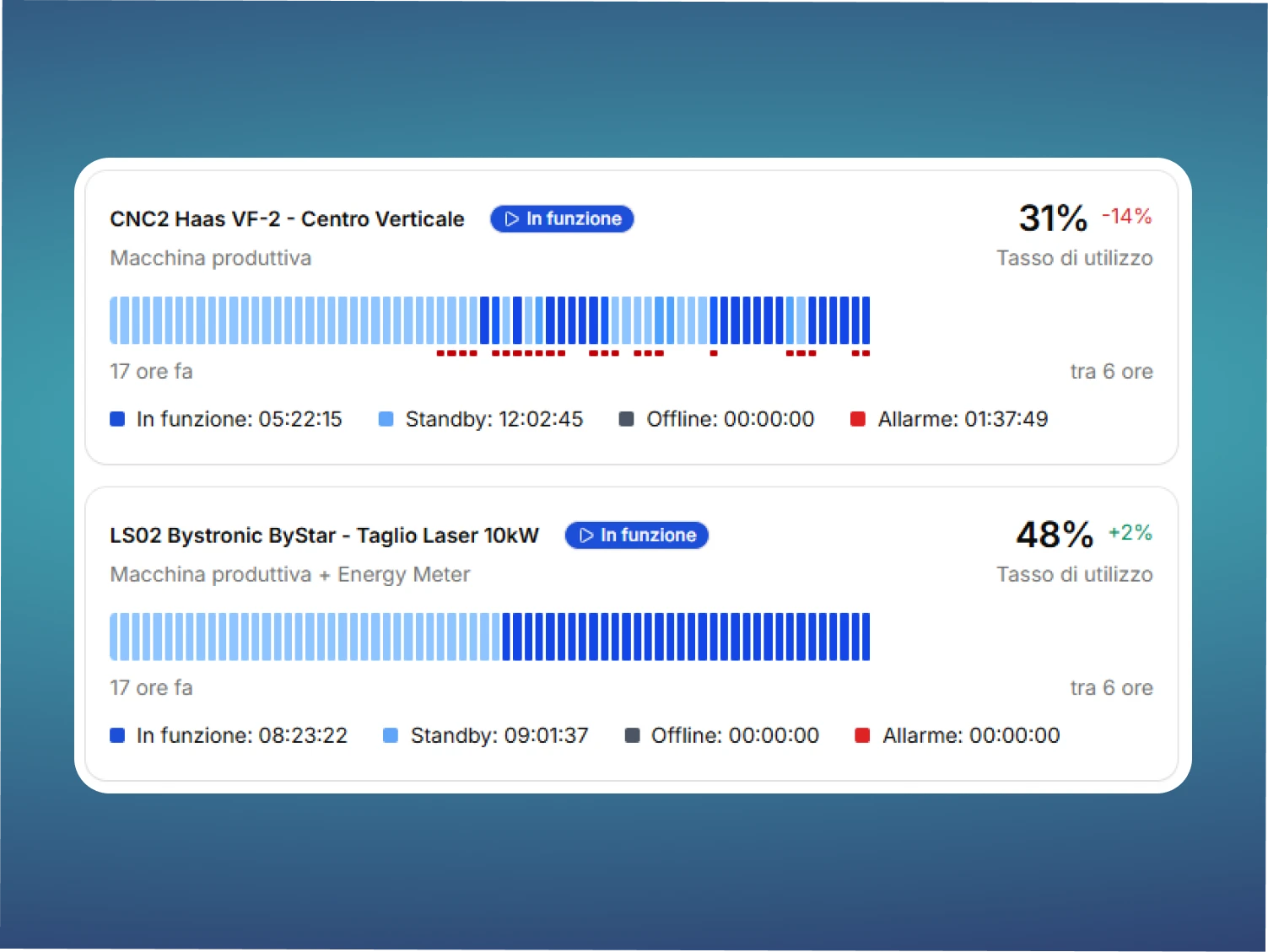
To calculate a reliable utilization rate, Zerynth aggregates data from PLCs or electrical current sensors. This allows for the definition of three precise operational states:
- Working Time: This state is triggered when the asset performs its intended cyclic work. Technically, it is validated through digital “in-cycle” signals or when power consumption exceeds a constant predefined threshold for a minimum required duration.
- Idle Time: The machine is on but not producing. This state indicates the asset is in standby—waiting for materials, an operator intervention, or undergoing a warm-up phase. Monitoring Idle time is essential for quantifying energy consumed without an economic return.
- Alarm Time: The machine is blocked by an error reported by its onboard electronics. The platform records the exact duration of each alarm, facilitating Mean Time Between Failures (MTBF) analysis.
The formula used is:
(Working Time ÷ (Working + Idle + Alarm Time)) × 100.
The result is a percentage that reflects true asset saturation relative to total available time.
Shift Analysis: The Core of Operational Value
Daily aggregated data often masks structural problems. The real breakthrough happens when you analyze the Utilization Rate by Work Shifts. This Zerynth feature allows you to isolate the performance of specific teams or times of day, revealing dynamics that are invisible at a global level.
Identifying “Hidden Capacity”
A plant may appear saturated, but shift analysis often reveals that the Utilization Rate drops significantly during the final hour of a shift or during team handovers. These “micro-losses,” when summed up monthly, represent hours of lost potential production. Identifying them allows you to recover capacity without investing in new machinery.
Benchmarking and Standardizing Best Practices
By comparing the morning shift to the night shift, you might notice that one team consistently achieves a 5% higher utilization rate. Analyzing the data helps clarify whether the difference is due to better setup management or more efficient maintenance procedures. The goal is not surveillance, but rather standardizing best practices across the entire organization.
Monitoring Startups and Shutdowns
Granular analysis shows exactly how long it takes for the factory to reach full speed at the start of a shift. If Idle Time is high during the first 30 minutes of every shift, there is a logistical or preparation issue that can be solved by adjusting work organization, rather than the machine itself.
Optimizing Industrial Production with a Data-Driven Strategy
Measuring the Utilization Rate is the first step toward transforming a shop floor into an optimized environment. When you stop relying on estimates and start observing how your assets behave shift after shift, you gain the tools to reduce energy costs and increase throughput.
Machine state monitoring is not an isolated activity—it is the foundation for production planning that respects deadlines and protects operating margins. With Zerynth data, every decision—from investing in a new work center to reorganizing shifts—is supported by objective technical evidence.
Share This Story, Choose Your Platform!
About the Author: Alice Benozzi