Industrial AI
Production Order Management and How to Identify Real Factory Delays
Quando il sistema gestionale mostra un ordine di produzione "al 60%", cosa sta misurando davvero? Indica che sono stati realizzati 600 pezzi su 1.000, che è stato consumato il 60% del tempo previsto a tempario, oppure che 600 pezzi sono stati effettivamente verificati come conformi? Senza una risposta univoca, il controllo dell'avanzamento della produzione rischia di basarsi su stime teoriche o percezioni soggettive. Nelle PMI manifatturiere, la gestione dell'avanzamento della produzione viene ancora spesso affidata alle sole dichiarazioni manuali raccolte a fine turno dagli operatori. Per capire se una commessa sta procedendo secondo i piani occorre unire l'intenzione
Analysis of Machine Utilization Rate: Optimizing Industrial Asset Efficiency
The efficiency of any manufacturing plant lies in the ability to turn available asset time into actual production. The gap between a machine being powered on and actually creating value has a direct impact on operating costs and the ability to meet production schedules. In Zerynth, the Utilization Rate is a metric that maps asset activity through physical signals, eliminating the errors and delays common in manual reporting. Here is a breakdown of how it’s calculated and why shift analysis is the true key to uncovering hidden inefficiencies. Technical Determination of Machine States To calculate a reliable utilization
Turning industrial machinery maintenance into a competitive advantage
Has a machine ever stopped without warning, leaving production at a standstill and your team scrambling for answers? In most cases, that failure did not come out of nowhere. It was preceded by a sequence of weak signals. In this article, we explore how industrial machinery maintenance can evolve from a cost center into a competitive advantage thanks to IoT and AI. Reactive industrial machinery maintenance is no longer enough. To stay in control, you need to anticipate problems and turn data into action. In other words, the way we think about maintenance must change. From unexpected breakdowns
The invisible bottleneck: why technical documentation is slowing down your production
How much time do you lose every day looking for the latest version of a procedure or trying to decipher a note written on an oil-stained manual? In a smart factory, every minute counts, yet the biggest obstacle often remains invisible: fragmented, outdated documentation locked in the minds of just a few people. If the term artificial intelligence for SMEs makes you think only of sensors and robots, there is a truth we are still ignoring: without a solid documentation base, no smart factory can be built. Document chaos and ghost know-how In small and medium-sized industrial companies,
Production planning: is your real capacity different from the theoretical one?
When it comes to production planning, many SMEs still treat shift schedules as the ultimate reference point: eight planned hours are assumed to mean eight hours of value creation. But is that really the case? In reality, machines often spend more time in standby than actually producing. This is where the paradox of the planned shift becomes evident. When strategies are built solely on theoretical data, costly decisions are almost inevitable. This article aims to close a critical gap: explaining how to move from theory to reality by measuring real capacity using objective data. Production planning must therefore evolve
Artificial Intelligence for Industrial SMEs: Costs, Advantages, and First Steps
Until a few years ago, talking about Artificial Intelligence in the factory meant evoking futuristic scenarios or investments only accessible to industry giants. Today, the narrative has changed, but confusion often remains about what this technology truly is when it descends to the production plant level. For a manufacturing company, AI should not be considered a digital "gamble" or a simple software to install. It is a technological system in all respects. And like any new tool introduced into the workshop – whether it’s a machining center or a logistics system – it requires an implementation strategy, a
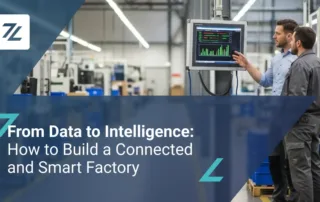
From Data to Intelligence: How to Build a Connected and Smart Factory
A smart factory starts from a clear need: understanding what truly happens on the shop floor. Machine states, energy usage, cycle times, product quality Many companies already collect data, but it often remains scattered across files, disconnected software, or handwritten notes. The result is a fragmented view that slows down decisions, analysis, and improvements. A smart factory gives a precise and real-time picture of performance, bottlenecks, and waste. This visibility is no longer optional. It’s essential for improving productivity and efficiency, a theme highlighted in our analysis of Italian manufacturing competitiveness. The Digital Path: From Data Collection
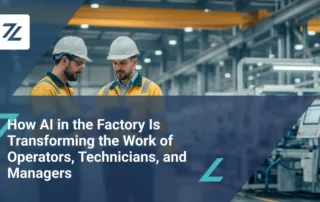
How Artificial Intelligence in the Factory Is Transforming the Work of Operators, Technicians, and Managers
Artificial intelligence in the factory is revolutionizing how people and technology interact. It’s no longer just about automation, but about collaboration with intelligent systems that can analyze, predict, and suggest actions. Many companies are exploring AI, but the real challenge is moving from intention to implementation. Zerynth helps manufacturers turn data into a daily strategic resource. We embrace a collaborative approach: AI that enhances human work, improving decision-making, safety, and productivity. This collaborative artificial intelligence model differs from traditional automation because it keeps human experience and judgment at the center. The New Role of Senior Operators Senior operators
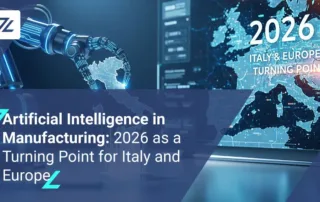
Artificial Intelligence in Manufacturing: 2026 as a Turning Point for Italy and Europe
The European manufacturing industry is on the brink of a new revolution: artificial intelligence is no longer a promise but a real driver of growth, resilience, and competitiveness. In 2026, AI becomes an integral part of industrial strategies. Italian and European companies will no longer see it as an isolated optimization tool, but as a pillar of digital and production transformation. From Automated to Intelligent Factories Today’s industrial landscape is complex: high energy costs, fragmented supply chains, sustainability pressures, and the need for greater productivity.In this context, artificial intelligence in the manufacturing industry becomes the engine of a profound transformation
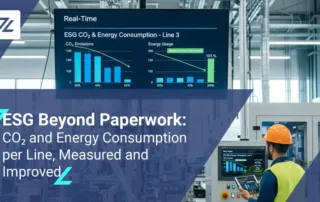
ESG That Doesn’t Stay on Paper: CO₂ and Energy Consumption per Line, Measured and Improved
Discover how one company turned energy and CO₂ data into actionable insights — reducing the environmental impact of each production line while improving energy efficiency, sustainability, and ESG positioning. How can manufacturers gain visibility into the environmental impact of their production lines? Many companies today are working to reduce their environmental footprint and comply with Industry 5.0 and ESG regulations, yet they often lack precise visibility into energy use and emissions per line or machine.Energy consumption monitoring solves this problem by providing accurate data to set realistic and measurable targets. This case study shows how reliable data is essential